Introduction: The Limits of Sight and Sound in the Digital World
For the better part of the last century, the primary methods of interaction between humans and their machines—whether those machines were mainframe computers, telephones, or modern smartphones—have been almost exclusively reliant on the dual senses of sight and sound, employing visual displays to present information and auditory alerts or verbal cues to signal events, creating a rich yet fundamentally two-dimensional channel of communication that relies solely on what we see and what we hear.
This heavy dependence on visual and auditory input has necessitated users to dedicate significant cognitive attention to the screen or speakers, often diverting focus from the physical environment or real-world tasks, contributing to issues like distracted driving and reducing the overall sense of intuitive physical connection that we naturally have with non-digital tools and instruments, demonstrating a clear bottleneck in the quest for truly seamless technological integration.
While these sensory channels are undeniably effective for conveying complex data, they inherently fail to capture the vital, nuanced richness of human interaction, which is fundamentally grounded in touch and physical feeling, a sensory channel that allows us to instinctively gauge texture, resistance, weight, and distance, crucial elements of spatial awareness and intuitive tool manipulation.
The technological frontier is now aggressively moving to reclaim this lost sense, recognizing that the most advanced and integrated user experiences will require engaging the sense of touch to provide a more immersive, safer, and inherently multisensory interaction model, one that feels less like staring at a screen and more like manipulating a tangible physical object.
This revolution is entirely driven by the rapid evolution and deployment of Haptic Feedback Technology, a sophisticated discipline that uses specialized actuators to simulate the sensation of pressure, vibration, texture, and force, finally bridging the massive sensory gap between our digital lives and our deeply physical world.
Pillar 1: Deconstructing the Science of Haptics
Haptic technology leverages the body’s natural sense of touch (haptics) by engaging receptors in the skin and muscles, creating the illusion of physical interaction.
A. Understanding the Sense of Touch (Haptics)
Haptics refers to the entire range of sensations related to touch, manipulation, and physical feedback.
- Tactile Feedback: This relates to the sensations felt on the skin, such as texture, temperature, and localized vibration, which are primarily detected by receptors just below the skin’s surface (Meissner corpuscles, Pacinian corpuscles).
- Kinaesthetic Feedback: This involves the sensation of force, movement, and position, which is detected by receptors in the muscles, tendons, and joints, allowing us to perceive the weight and resistance of an object.
- The Combined Experience: True haptic feedback aims to engage both the tactile and kinaesthetic senses to create a believable and immersive experience, such as feeling the resistance of a virtual button press followed by the subtle click of activation.
B. Core Haptic Actuator Technologies
The feeling of touch is created by specialized devices that generate precise physical movements or vibrations.
- Eccentric Rotating Mass (ERM) Motors: These are the traditional, simple vibration motors found in older cell phones and game controllers. They use a small, unbalanced weight attached to a motor shaft. When the motor spins, the imbalance creates a generalized, non-directional vibration.
- Linear Resonant Actuators (LRAs): LRAs are more precise and energy-efficient than ERMs. They use a spring-mounted mass and voice coil to generate short, sharp, highly localized vibrations and clicks, enabling the nuanced haptic effects found in modern smartphones and touchpads.
- Piezoelectric Actuators: Piezo haptics offer the highest fidelity and fastest response time. They use materials that change shape rapidly when an electric charge is applied, allowing them to create the sensation of different textures, sudden sharp taps, and detailed surface movements.
C. Advanced Haptic Rendering
The sophistication of haptic experiences lies in the software and algorithms that control the actuators.
- Waveform Synthesis: This involves designing specific vibration patterns (waveforms) that correspond to different digital events (e.g., a short, gentle pulse for a successful message send versus a long, ramping vibration for an incoming call).
- Haptic Libraries: Developers use pre-defined libraries of haptic effects that standardize sensations—a “tap” feels consistent across apps, for example—allowing for rapid development and consistent user experience.
- Tactile Graphics: These are algorithms that translate visual or textual information into physical textures or force feedback, such as generating the sensation of running your finger over a fabric texture on a flat glass screen.
Pillar 2: Haptics in Mainstream Consumer Electronics
The primary success of haptic feedback has been its subtle, transformative role in devices we use every day, particularly those relying on touchscreens.
A. The Modern Smartphone Interface
Haptics provides the crucial physical reassurance missing from glass screens.
- Simulating the Click: The subtle “click” felt when pressing a virtual key on a smartphone keyboard provides tactile confirmation that the input was registered, dramatically reducing typing errors and improving speed without requiring the user to visually verify every press.
- Notification Differentiation: Different notification types—such as a text message, a calendar alert, or an application reminder—can be encoded into unique haptic signatures, allowing the user to distinguish between alerts without looking at the screen, a major convenience for safety and context.
- Force Touch and Pressure Sensitivity: Advanced haptics allow the system to respond differently based on the pressure applied to the screen (Force Touch), simulating deeper presses or firm pushes to unlock secondary functions within apps.
B. Gaming and Entertainment
Haptics exponentially increases the immersion and realism of virtual experiences.
- Directional Feedback: Modern game controllers use multiple localized actuators to provide directional feedback. If a player is hit on the right side in a game, the vibration is felt only in the right grip, improving spatial awareness and realism.
- Simulated Textures: In racing games, the haptic system can simulate the difference between driving on asphalt, gravel, or icy surfaces through nuanced vibration patterns, greatly enhancing the player’s feeling of control and connection to the virtual environment.
- Trigger Resistance: Newer controllers include actuators in the shoulder triggers that can simulate the tension of pulling a bowstring, the sudden resistance of firing a weapon, or the crunch of hitting the brake pedal, tying the physical feel directly to in-game action.
C. Enhanced Digital Accessibility
Haptic feedback opens new doors for users who are visually or hearing impaired.
- Tactile Navigation: Haptic signals can guide users through menus and applications without relying on visual cues. For example, a phone could vibrate once for “up” and twice for “down” in a list, making it easier for visually impaired individuals to navigate.
- Translating Sound: Haptics can translate auditory information into vibrational patterns, allowing individuals with hearing impairments to perceive certain non-speech sounds, such as alarms or environmental alerts, through touch.
- Braille Displays: Advanced, high-resolution haptic systems can create dynamic, refreshable Braille displays on flat surfaces, making digital text instantly tactile and accessible for the blind community without relying on cumbersome mechanical pins.
Pillar 3: The Haptic Revolution in Virtual and Augmented Reality (VR/AR)
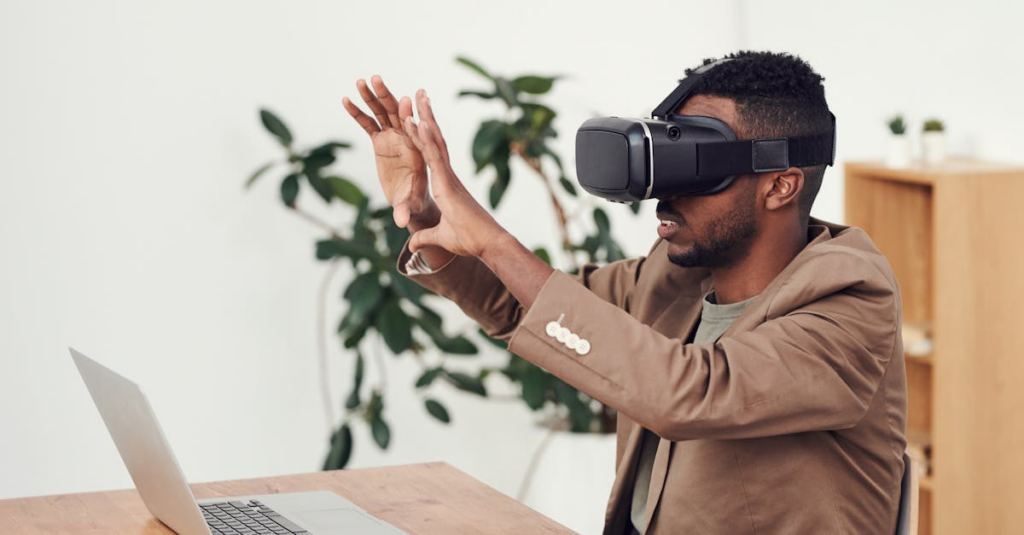
In immersive environments, haptics is the essential ingredient that truly sells the illusion of a physical world, making virtual objects feel tangible.
A. The Challenge of “Feeling” Virtual Objects
VR and AR environments require convincing physical feedback to achieve true immersion.
- Virtual Object Resistance: When a user reaches out and grabs a virtual cup, haptic gloves or controllers must provide localized resistance and pressure to simulate the firmness and shape of the cup, preventing the hand from simply passing through the air.
- Simulated Weight: Advanced haptic exoskeletons can use motorized resistance or force feedback to simulate the weight of a virtual object, making a virtual hammer feel heavier than a virtual feather, adding a critical layer of realism.
- Surface Texture Rendering: VR interfaces rely on creating the sensation of different textures—rough wood, smooth metal, soft fabric—on the hand or fingertip, transforming the way users interact with virtual products, designs, and environments.
B. Haptic Devices for Immersive Training
The ability to feel virtual objects is revolutionizing professional training and simulation.
- Surgical Training: Medical students can use haptic systems to practice complex surgical procedures, allowing them to feel the resistance of tissue, the tension of sutures, and the pressure of instruments with a high degree of fidelity, minimizing risk during live operations.
- Mechanical Repair Simulation: Trainees in fields like automotive or aerospace repair can use haptic gloves to practice assembling or disassembling virtual machinery, feeling the correct torque of a bolt or the precise fit of a component.
- Military and First Responder Training: Haptics provide realistic shock and force feedback in combat or rescue simulations, enhancing the stress and realism of the training environment and improving muscle memory response to extreme conditions.
C. Haptics in the Metaverse and Digital Commerce
Haptic feedback is poised to change how we shop and interact in shared virtual spaces.
- Virtual Product Inspection: Consumers in virtual stores will be able to “feel” the texture of a virtual garment or the weight and finish of a digital piece of furniture before making a purchase, greatly reducing uncertainty in online shopping.
- Shared Physical Interaction: In collaborative virtual environments (metaverses), haptics will enable participants to feel a virtual handshake, a pat on the shoulder, or the shared manipulation of a virtual tool, enhancing social presence and teamwork.
- Enhanced Digital Art and Creation: Digital sculptors and artists will use haptic styluses and tablets to feel the virtual clay or material they are manipulating, bringing a physical dimension back into digital creative processes.
Pillar 4: Haptics Beyond the Screen and Handhelds
The application of haptic technology is rapidly expanding into non-traditional fields, integrating touch into everyday objects and environments.
A. Automotive Safety and Driver Interface
Haptics can provide crucial, non-distracting alerts to drivers.
- Steering Wheel Feedback: Haptic actuators embedded in the steering wheel can provide subtle, directional vibrations to alert a driver to lane departure, imminent collision threats, or drifting, providing a non-visual, intuitive warning that is often faster to process than an auditory beep.
- Tactile Dashboards: Replacing smooth glass dashboards with haptic surfaces allows designers to simulate physical buttons, dials, and switches that provide tactile feedback, enabling drivers to interact with climate control or navigation without taking their eyes off the road.
- Seat Vibration Alerts: The seat itself can become a haptic feedback mechanism, using localized vibration patternsto indicate which direction a threat is coming from (e.g., left seat vibration for a car approaching on the left), enhancing situational awareness.
B. Wearable Technology and Biometric Feedback
Integrating haptics into clothing and accessories for discreet communication and wellness tracking.
- Navigation Clothing: Smart clothing or vests equipped with haptic actuators can provide directional cues for navigation (e.g., a tap on the left shoulder to turn left) without requiring the user to look at a map, ideal for walking or cycling.
- Wellness Monitoring: Wearables can use gentle haptic pulses to provide biofeedback, such as reminding a user to adjust posture, take a breath during stress spikes, or stand up after long periods of sitting, aiding in proactive health management.
- Discreet Communication: Haptics allows for silent, private communication in professional or social settings, such as using pre-defined patterns to signal urgent messages or social cues between colleagues or friends.
C. Medical Rehabilitation and Prosthetics
Haptics provides a crucial connection for individuals using artificial limbs and supports.
- Sensory Feedback for Prosthetics: Integrating sensors and haptic actuators into advanced prosthetic hands allows the user to feel the texture, pressure, and temperature of objects they grasp, dramatically improving dexterity, confidence, and the sense of embodiment.
- Physical Therapy Guidance: Haptic devices can be used in rehabilitation to gently guide patients through specific, repetitive movements during physical therapy sessions, ensuring correct form and maximizing recovery efficacy.
- Telemedicine and Remote Procedures: Haptic technology allows physicians to perform sensitive remote physical examinations or guide a distant assistant through a procedure, providing the crucial sense of touch needed for accurate diagnosis and manipulation.
Pillar 5: Scaling Challenges and the Future of Haptic Design
To move beyond specialized applications, haptic technology must overcome technical limitations and standardize its interaction language.
A. Technical and Engineering Hurdles
Achieving true, high-fidelity haptics remains a significant engineering challenge.
- Power Consumption: High-fidelity haptic effects, especially those involving continuous force feedback or complex texture rendering, consume significant battery power, limiting their widespread use in small, portable devices.
- Miniaturization and Cost: While LRAs and Piezo actuators are improving, creating micro-scale actuators that can deliver the necessary force and resolution across a large surface (like an entire desktop) remains prohibitively expensive and technically complex.
- Sustained Force Feedback: Delivering sustained resistance or weight (kinaesthetic feedback) without bulky, external motors or exoskeletons is still a major unsolved problem for truly immersive interfaces.
B. Standardization and Design Language
For haptics to become universal, designers need a common vocabulary of touch.
- Universal Haptic Language: There is a need to develop a standardized library of haptic sensations (a “haptic alphabet”) that maps digital events to consistent physical feelings across all platforms, ensuring that a “warning tap” feels the same on a phone, a watch, and a car dashboard.
- Tools for Haptic Creation: Developers currently lack user-friendly, comprehensive software tools for easily designing, editing, and previewing complex haptic waveforms, similar to the tools available for visual and audio design.
- Integration into Design Thinking: Haptic considerations must move from being an afterthought to an intrinsic part of the initial user interface design process, ensuring that touch feedback is meaningful and complementary, not just an annoying vibration.
C. The Multimodal Future
The most effective interfaces will seamlessly weave together all senses, not just touch.
- Fusion of Senses: The future interface will synchronize haptic, visual, and auditory cues perfectly. For instance, a virtual button press will produce a visual change, an auditory click, and a tactile sensation all at the exact same millisecond.
- Contextual Awareness: Smart haptic systems will use AI and sensor data (e.g., the user’s location, heart rate, or current task) to dynamically adjust the intensity and urgency of the haptic feedback, preventing unnecessary distraction or annoyance.
- Transparent Interaction: The ultimate goal is for haptic feedback to become so intuitive and subtle that users interact with technology transparently, relying on muscle memory and instinct, feeling the connection without conscious thought, truly bridging the digital and physical divide.
Conclusion: Touch as the Key to Digital Intuition

Haptic feedback technology is rapidly asserting itself as the indispensable third pillar of modern user interface design, joining sight and sound.
This technology directly addresses the sensory deficit inherent in glass-based electronics by simulating the vital physical sensations of texture, pressure, and resistance.
Driven by precise actuators like LRAs and Piezo elements, haptics now provides the tactile confirmation that dramatically improves speed and reduces errors in everyday tasks, such as typing on a virtual keyboard.
The integration of advanced haptics is fundamentally transforming immersive technologies, making virtual reality and gaming experiences feel convincingly tangible and physically real.
Beyond entertainment, haptics is enhancing crucial safety applications, including providing non-distracting directional alerts to drivers in modern automotive systems.
To achieve mass adoption, the industry must overcome technical hurdles related to power efficiency and establish a universal, standardized language for tactile communication across diverse devices.
Ultimately, the future of interaction is multimodal, where the precise sense of touch provided by haptic technology will unlock truly intuitive, safe, and deeply immersive connections between humans and the digital world.